Switch to Aesthetics Depot Canada



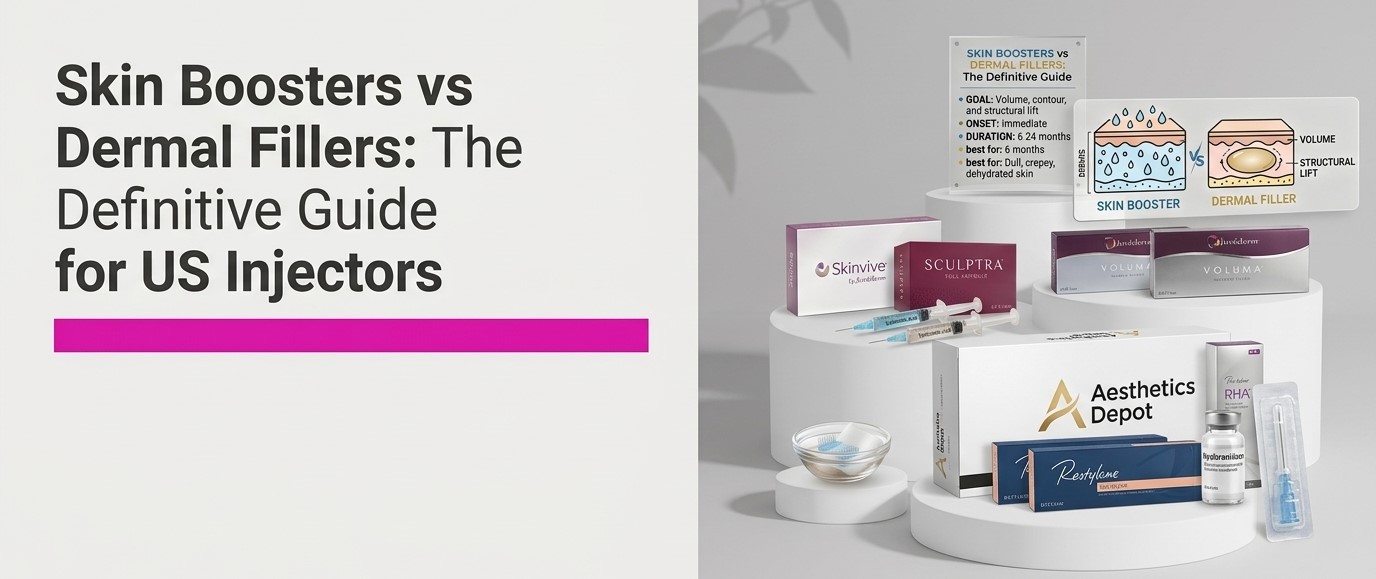
Two syringes of hyaluronic acid sit on the same tray, and the consults that sell them have almost nothing in common.
- A dermal filler occupies space, lifts structure, and holds its shape because it is cross-linked to resist deformation.
- A skin booster does the opposite job: it disperses through the dermis, draws water, and stimulates fibroblast activity so the tissue itself behaves younger.
The Skin Booster vs Filler decision comes down to whether your patient wants a changed shape or changed skin. Injectors who separate those two conversations at the consult stage stop losing patients who came in asking for glow and left holding a quote for cheek volume they never wanted.
What Actually Separates a Booster from a Filler?
Rheology (how the injectable settles under the skin), injection plane, and mechanism. A cross-linked filler carries a high elastic modulus, meaning it resists compression and stays where you place it, which is why Voluma sits on the surface and holds projection for a year or more. Boosters carry low or no cross-linking, spread through the superficial to mid dermis, and work by hydration plus biostimulation rather than by volume.
Practical differences your protocols will feel:
- Plane: Fillers go deep dermal to the top of the bone’s surface tissue. Boosters go intradermal in microdroplets or small blebs
- Technique: Linear threading, fanning, and bolus versus microdroplet grids spaced roughly 0.5 to 1 cm apart
- Volume: 1 to 2 mL per treatment area versus small aliquots distributed widely
- Onset: Filler results are immediate, booster results build over four to twelve weeks
- Course: One session with touch-up versus a series of two to four sessions spaced four weeks apart
- Retreatment: Annual to biannual for filler, roughly every six months for boosters
That last point is the commercial one. Boosters are a subscription behavior and fillers are an event.
Which Skin Boosters Can US Injectors Legally Use?
This is where the global conversation and the American one diverge. Skinvive by Juvéderm remains the anchor product for skin boosters USA clinics can use on-label, FDA-approved since 2023 for improving cheek smoothness.
In June 2026, Allergan Aesthetics secured a second indication for reducing neck lines in adults over 21, which opened up the area patients have been requesting for years while injectors had only off-label options.
Alongside it sit the biostimulators. Sculptra, a poly-L-lactic acid injectable, builds collagen over roughly three months across a series of sessions. Hyper-dilute Radiesse is widely used for neck and décolleté skin quality, though that application is off-label and belongs in your documented protocol and consent.
Which Patients Should Hear About Boosters First?
The ones fillers were never designed to satisfy:
- Patients in their late twenties and thirties with dull, crepey, or dehydrated skin and no meaningful volume loss
- Filler-experienced patients who feel overfilled and want to step back without losing their appointment cadence
- Patients terrified of looking treated, who will accept a quality change long before a shape change
- Neck, décolleté, and hand presentations where volume correction reads unnatural
- Post-resurfacing and post-microneedling patients maintaining results between bigger procedures
- Men, who convert on skin quality language far more readily than on contour language
Run the booster conversation for anyone whose complaint uses texture words. Glow, tired, dull, flat, and crepey all point toward the dermis. Hollow, sagging, and flat cheeks point toward structure.
How Do You Sequence and Price the Two Together?
Sell boosters as a course, never as a single syringe. Patients judge value against the full series outcome, so pricing three sessions upfront at a modest saving protects both the clinical result and your rebooking rate. Practices commonly run boosters as the entry treatment, then introduce filler once trust is established, reversing the traditional order and producing a far stickier patient.
Sequencing that works:
- Toxin and boosters at the same visit, treating different planes and different goals
- Boosters two to four weeks after energy-based resurfacing rather than the same day
- Filler first for structural cases, boosters added at the review appointment to finish skin quality
- Booster series timed to conclude four weeks before a wedding or event date
Chair time matters here. A booster session runs 20 to 30 minutes and fills the gaps between longer appointments without requiring a second injector.
How should you stock boosters differently from filler?
Demand patterns differ, so ordering patterns should too. Filler moves in single syringes tied to individual bookings. In contrast, boosters move in multiples because every patient who starts a series has committed to two or three more visits already on the calendar.
Build your par levels around courses rather than units. Track how many patients start a series each month, multiply by the sessions remaining, and order against that number. Keep cold chain discipline tight, since HA-based products need consistent refrigeration and a logged thermometer. Hold hyaluronidase regardless of how superficial your booster work is, because your filler patients share the same treatment room.
Order from wholesalers who verify your license at account opening and ship US-market product with English labeling and intact lot numbers. That verification step is what keeps your inventory defensible if a board ever asks.
| Skin Booster | Dermal Filler | |
| Goal | Skin quality, hydration, glow | Volume, contour, structural lift |
| Product | Low or non-cross-linked HA, PLLA, hyper-dilute CaHA | Cross-linked HA with high elastic modulus |
| Plane | Superficial to mid dermis | Deep dermal to surface |
| Technique | Microdroplet grid, 0.5 to 1 cm spacing | Linear threading, fanning, bolus |
| Onset | Builds over 4 to 12 weeks | Immediate |
| Duration | Around 6 months | 6 to 24 months by product and area |
| Course | Series of 2 to 4 sessions, 4 weeks apart | Single session plus touch-up |
| Best Fit | Dull, crepey, dehydrated skin with minimal volume loss | Hollowing, sagging, defined structural correction |
| US Options | Skinvive (cheeks and neck), Sculptra, hyper-dilute Radiesse off-label | Full Juvéderm, Restylane, RHA and Belotero ranges |
| Chair Time | 20 to 30 minutes | 30 to 45 minutes |
Open a wholesale account with Aesthetics Depot and stock your booster and filler menu from one verified supplier.